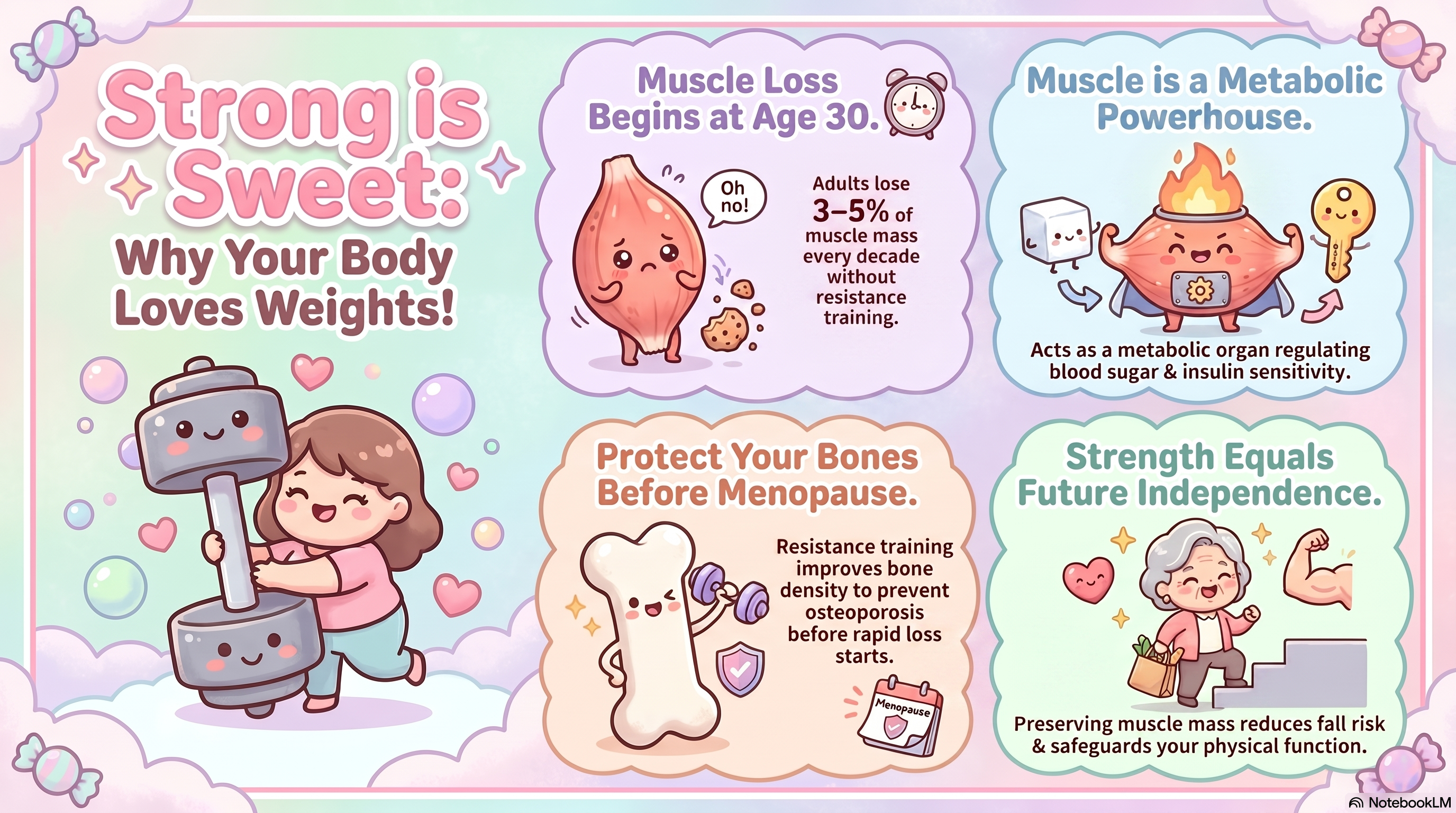
Myth: Strength training is only for men, athletes,s or Bodybuilders

One of the biggest myths in women’s health is that strength training is only for men, athletes, or people looking to build large muscles.
As a result, many women spend years focusing primarily on walking, yoga, cardio, aerobics, or other calorie-burning workouts while avoiding resistance training altogether.
The assumption seems harmless.
After all, walking is good for health.
But what if this well-intentioned advice is causing us to overlook some of the most important health challenges women face after the age of 30?
The reality is that strength training is not about becoming muscular. It is about preserving muscle mass.
Yet despite growing scientific evidence, resistance training remains one of the most underutilised tools in women’s preventive healthcare.
Perhaps it is time to challenge the myth.
Because the question is not whether women should lift weights.
The question is why so many women are still being told that they don’t need to.

Myth 1- Walking is enough to maintain Strength as We Age
Most women are surprised to learn that muscle loss begins much earlier than they think.
According to the U.S. National Institutes of Health (NIH), adults begin losing muscle mass around 30 years of age, at a rate of approximately 3-5% per decade if no preventive measures are taken.
This gradual decline, known as sarcopenia, affects strength, mobility, balance, and overall physical function.
The consequences go far beyond appearance.
Loss of muscle mass is associated with reduced mobility, increased risk of falls, insulin resistance, and declining functional independence later in life.
Walking is excellent for heart health.
However, walking alone does not provide the progressive mechanical overload required to preserve or build muscle mass.
Strength training does.

Myth 2- Women’s Health Is Primarily about Weight Loss
Much of the talk around women’s health fitness revolves around losing weight.
Calories burned
Steps counted.
Kilograms lost.
A woman may lose weight while simultaneously losing muscle.
The scale cannot distinguish between fat loss and muscle loss.
The distinction matters because muscle functions as a metabolic organ. It plays an essential role in glucose regulation, insulin sensitivity, physical function, and healthy ageing.
Research shows that age-related muscle decline is associated with increased risk of metabolic disorders, including insulin resistance and type 2 diabetes.
Perhaps we should spend less time asking women how much weight they have lost and more time asking how much strength they have preserved.

Myth 3- Bone Health Becomes Important After Menopause
The healthcare system often begins discussing osteoporosis when women reach their 50s or 60s.
The problem is that bone health becomes important much earlier.
Women typically reach peak bone mass by their late twenties or early thirties. After this point, bone breakdown gradually exceeds bone formation.
Following menopause, declining estrogen levels accelerate bone loss, with some women losing upto 20% of their bone mass within the first decade after menopause.
This raises an important question.
If bone loss begins years before osteoporosis is diagnosed, why are we waiting so long to discuss prevention?
Research consistently shows that resistance training helps maintain or improve bone mineral density, particularly in post menopausal women. Recent systematic reviews and meta-analyses continue to support resistance training as an effective strategy for preserving bone health.

The Bigger Issue
Perhaps the reason we are missing women’s health needs is that we continue to frame exercise primarily as a tool for weight loss.
Women’s health after 30 is not simply about becoming thinner.
It is about preserving muscle.
Protecting bone.
Maintaining metabolic health
Reducing future frailty.
And safeguarding independence.
Walking remains one of the most accessible and beneficial forms of physical activity.
But walking alone cannot solve the energy challenge women face as they age.
Strength training is not just for men.
It is not just for athletes.
It is certainly not just for bodybuilders.
It may be one of the most underutilised preventive health interventions available to women today.
The question is no longer whether women should walk; the question is why strength training is still being treated as optional when the evidence clearly suggests that it should be considered essential.

I am Dr Gazala Shaikh. Doctor, Medical Writer, and Health Content Strategist with over 10 years of clinical experience in healthcare.
I write on women’s health, hormonal conditions, and evidence-based wellness, translating complex medical science into content that actually helps.
If this article gave you clarity, share it with one woman who needs to read it.
Follow me here on LinkedIn for more.