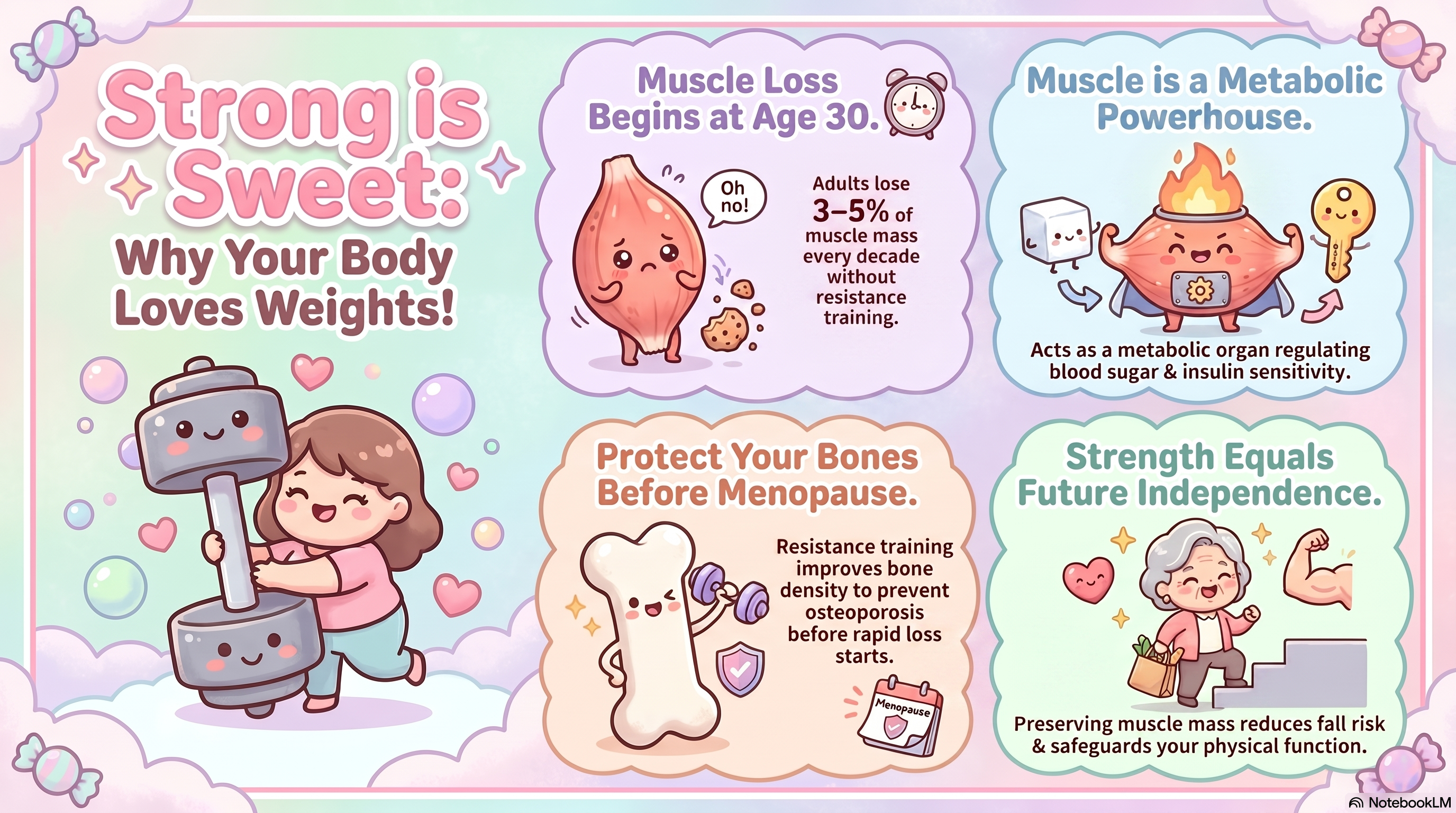
Myth: Strength training is only for men, athletes,s or Bodybuilders
One of the biggest myths in women’s health is that strength training is only for men, athletes, or people looking to build large muscles.
As a result, many women spend years focusing primarily on walking, yoga, cardio, aerobics, or other calorie-burning workouts while avoiding resistance training altogether.
The assumption seems harmless.
After all, walking is good for health.
But what if this well-intentioned advice is causing us to overlook some of the most important health challenges women face after the age of 30?
The reality is that strength training is not about becoming muscular. It is about preserving muscle mass.
Yet despite growing scientific evidence, resistance training remains one of the most underutilised tools in women’s preventive healthcare.
Perhaps it is time to challenge the myth.
Because the question is not whether women should lift weights.
The question is why so many women are still being told that they don’t need to.
Myth 1- Walking is enough to maintain Strength as We Age
Most women are surprised to learn that muscle loss begins much earlier than they think.
According to the U.S. National Institutes of Health (NIH), adults begin losing muscle mass around 30 years of age, at a rate of approximately 3-5% per decade if no preventive measures are taken.
This gradual decline, known as sarcopenia, affects strength, mobility, balance, and overall physical function.
The consequences go far beyond appearance.
Loss of muscle mass is associated with reduced mobility, increased risk of falls, insulin resistance, and declining functional independence later in life.
Walking is excellent for heart health.
However, walking alone does not provide the progressive mechanical overload required to preserve or build muscle mass.
Strength training does.
Myth 2- Women’s Health Is Primarily about Weight Loss
Much of the talk around women’s health fitness revolves around losing weight.
Calories burned
Steps counted.
Kilograms lost.
A woman may lose weight while simultaneously losing muscle.
The scale cannot distinguish between fat loss and muscle loss.
The distinction matters because muscle functions as a metabolic organ. It plays an essential role in glucose regulation, insulin sensitivity, physical function, and healthy ageing.
Research shows that age-related muscle decline is associated with increased risk of metabolic disorders, including insulin resistance and type 2 diabetes.
Perhaps we should spend less time asking women how much weight they have lost and more time asking how much strength they have preserved.
Myth 3- Bone Health Becomes Important After Menopause
The healthcare system often begins discussing osteoporosis when women reach their 50s or 60s.
The problem is that bone health becomes important much earlier.
Women typically reach peak bone mass by their late twenties or early thirties. After this point, bone breakdown gradually exceeds bone formation.
Following menopause, declining estrogen levels accelerate bone loss, with some women losing upto 20% of their bone mass within the first decade after menopause.
This raises an important question.
If bone loss begins years before osteoporosis is diagnosed, why are we waiting so long to discuss prevention?
Research consistently shows that resistance training helps maintain or improve bone mineral density, particularly in post menopausal women. Recent systematic reviews and meta-analyses continue to support resistance training as an effective strategy for preserving bone health.
The Bigger Issue
Perhaps the reason we are missing women’s health needs is that we continue to frame exercise primarily as a tool for weight loss.
Women’s health after 30 is not simply about becoming thinner.
It is about preserving muscle.
Protecting bone.
Maintaining metabolic health
Reducing future frailty.
And safeguarding independence.
Walking remains one of the most accessible and beneficial forms of physical activity.
But walking alone cannot solve the energy challenge women face as they age.
Strength training is not just for men.
It is not just for athletes.
It is certainly not just for bodybuilders.
It may be one of the most underutilised preventive health interventions available to women today.
The question is no longer whether women should walk; the question is why strength training is still being treated as optional when the evidence clearly suggests that it should be considered essential.
Strength training supports muscle preservation, bone health, metabolism, and healthy aging in women.
I am Dr Gazala Shaikh. Doctor, Medical Writer, and Health Content Strategist with over 10 years of clinical experience in healthcare.
I write on women’s health, hormonal conditions, and evidence-based wellness, translating complex medical science into content that actually helps.
If this article gave you clarity, share it with one woman who needs to read it.
There was a time when seeds were just something we sprinkled on salads. But lately, I have been noticing that seeds are becoming popular among women.
As a doctor, I have come across countless questions about hormones. I did not expect a question like this.
“Can I manage my menstrual cycle with the same ingredients I add to my morning smoothie?”
The main question is: Is this another wellness trend headed for the internet graveyard, or is there real science behind it?
So let me break it down.
Seed cycling- When I first heard the term I though it had something to do with gardening.
But it turned out to be a nutritional approach. It has become popular with women who want natural support for PMS, PCOS, and hormonal balance.
The concept sounds simple enough. The science, however, is far more interesting.
Although seed cycling feels like a recent social media trend, the idea didn’t originate on TikTok. The practice has been circulating in naturopathic and functional medicine communities for over a decade, while research on individual seeds and women’s hormone health dates back to the 1990s. What is new, however, is the growing scientific interest in testing whether seed cycling gives measurable benefits.
But what does the science actually say?
What Is Seed Cycling?
Seed cycling means eating certain seeds at different times in your menstrual cycle.
It may gently support your hormones.
The idea is:
In the first half of your cycle, from your period to ovulation, eat seeds that may support healthy estrogen levels. Try flax and pumpkin seeds.
In the second half (after ovulation until your next period), eat seeds that may support progesterone. Sunflower and sesame seeds may help support overall balance.
Let’s understand it like this:
During the first half of the menstrual cycle, estrogen prepares the soil. It helps build up the uterine lining and creates the right environment for the egg.
After ovulation (when the egg is released), progesterone takes over as the gardener. It nurtures and maintains that environment in case a fertilised egg needs a place to grow,
If no pregnancy occurs, the body sheds the lining and starts preparing fresh soil for the next cycle.
Why Are Women Turning to Seed Cycling?
For many women, hormonal health can feel like solving a puzzle with missing pieces.
PMS, irregular periods, acne, mood swings, bloating, painful cramps and PMOS(PCOS) related symptoms can significantly affect daily life.
While conventional treatments are available and often effective, not every woman is looking for medication alone. Many are also searching for lifestyle and dietary approaches that may help them feel more in control of their health.
At the same time, there is growing awareness of the connection between nutrition and hormonal well-being.
Women are increasingly asking:
1- Are there foods that support hormonal health?
2- Can simple dietary changes complement medical treatment?
3- Can the food that I consume influence my menstrual cycle?
Seed cycling has emerged as one possible answer to these questions.
Part of its appeal is in its simplicity.
Unlike expensive supplements or wellness regimes, this involves foods that are already available in the kitchen and are also nutritious.
The practice also aligns with a broader move toward integrative health. In this approach, nutrition, exercise, stress management, and medical care work together, not alone.
Social media has further accelerated its popularity. Stories of women sharing better PMS symptoms, more regular cycles, and improved well-being have spread fast online. This has moved seed cycling from a niche wellness practice into the mainstream.
However, popularity does not always equal scientific validity.
While personal experiences can be valuable, they cannot replace clinical evidence. This raises an important question;
Is seed cycling simply a wellness trend, or does the science support the claims?
What Does the Research Show?
Research on seed cycling is still emerging, but the findings so far are encouraging. A recent systematic review looked at studies on seed cycling for PMOS and PMS. It found possible benefits. These included improved menstrual regularity and reduced symptom severity. It also found favourable changes in some hormonal and metabolic markers.
Researchers believe the nutrients and phytoestrogenic compounds in flax, pumpkin, sesame, and sunflower seeds may cause these effects.
However, there is an important caveat. Most available studies are small, and many examine individual seeds rather than the complete seed-cycling protocol. While early evidence suggests seed cycling may help some women, more large, rigorous clinical trials are needed.
Until then, it cannot be recommended as a proven treatment for PMS, PCOS, or hormonal imbalances. For now, it remains a promising nutritional strategy, supported by growing but not yet conclusive scientific evidence.
Why These Seeds Might Help?
While seed cycling is still being studied, the seeds in this plan are nutritional powerhouses. They contain compounds that may support hormonal and metabolic health.
Flax Seeds
Freepik
Commonly consumed early in the menstrual cycle, they are rich in lignans. Lignans are plant compounds that may affect how the body metabolises estrogen.
They are also a good source of omega-3 fatty acids, which are known for their anti-inflammatory properties and overall health benefits.
Pumpkin Seeds
Freepik
This provides zinc and magnesium, two minerals that play important roles in reproductive health. Zinc is involved in hormone production, while magnesium contributes to muscle function, mood regulation, and energy metabolism.
Sesame Seeds
Freepik
During the second half of the cycle, sesame seeds are often recommended.
They contain lignans and other bioactive compounds that may support hormonal balance.
Sunflower Seeds
Freepik
This seed provides vitamin E and selenium, both of which play roles in cellular and reproductive health.
It is important to note that no single seed acts like a hormone. Rather, these foods provide nutrients that may support the body’s natural hormone processes.
They can be part of an overall healthy diet.
The Evidence Gap We Need to Acknowledge
As appealing as seed cycling sounds, scientific honesty requires us to acknowledge the limitations of the current evidence
Most studies investigating it are relatively small and focus on individual seeds, rather than the complete seed cycling protocol. This makes it hard to tell whether the benefits come from seed cycling, the seeds’ nutritional value, or other diet and lifestyle factors.
The findings so far are encouraging, particularly for PMS symptoms, menstrual regularity, and certain aspects of PMOS.
However, larger and better-designed clinical trials are needed before seed cycling can be recommended as a proven therapeutic intervention.
For this reason, seed cycling should be a supportive nutrition strategy. It should not replace prescribed medication for PMS, PCOS, or serious menstrual disorders.
A Clinician’s Perspective
Seed cycling is generally safe, inexpensive, and nutritionally beneficial for most women. While it may support overall health and help with symptoms for some people, it is not a cure for PMS or PCOS. It should be used as a complementary strategy.
How to Incorporate These Seeds Into Everyday Meals
One reason seed cycling has gained popularity is that it is relatively easy to implement.
Try adding ground flax seeds to smoothies, oatmeal, yoghurt, or homemade rotis.
Pumpkin seeds can be sprinkled over salads, soups, vegetable dishes, or eaten as a snack.
During the second half of the cycle, add sesame seeds to chutneys, stir-fries, or roasted vegetables.
You can also use them in traditional foods like til laddoos.
Sunflower seeds work well in salads, yoghurt bowls, trail mixes, sandwiches, and smoothies.
Many women also make a simple seed mix for each phase of the cycle.
They add one to two tablespoons daily to foods they enjoy.
The goal is consistency rather than perfection.
Practical Tips for Women Who Want to Try Seed Cycling
If you decide to experiment with seed cycling, keep a few practical considerations in mind.
Whenever possible, use freshly ground flax and sesame seeds, as grinding may improve nutrient availability. Consistency matters more than exact timing.
Try to follow the protocol for at least two to three menstrual cycles.
Then evaluate any changes.
It can also be helpful to track symptoms such as mood, cramps, bloating, cravings, energy levels, and cycle length. This makes it easier to determine whether the practice is having a meaningful impact.
Most importantly, remember that nutrition is only one piece of the hormonal health puzzle. Adequate sleep, regular physical activity, stress management, and appropriate medical care remain equally important.
Final Takeaway
Seed cycling is an intriguing example of how nutrition may influence hormonal health. The science is promising, but we’re not yet at a point where we can call it a proven therapy. For now, it may be best seen as a low-risk nutrition practice. It can support full women’s healthcare, but it should not replace it.
Sometimes, the key point is not that food can fix everything.
Small, lasting diet changes can still support your overall well-being.
Why It Backfires for Most Women and the Version That Doesn’t
Whenever the patient is diagnosed with PCOS, they think losing weight will help them recover. It does, but not the aggressive approach. It has a technique, it has a pattern to follow. It is quite frustrating when we are doing everything right only to realise that the outcome is not in our favour.
She did everything right. She read the research. She joined the forums. Every woman in her PMOS(PCOS) support group was doing intermittent fasting. Her wellness influencer swore by 16:8 . Even a few medical websites said it could improve insulin sensitivity.
1-So she stopped eating breakfast.
2-Pushed her first meal to noon.
3-Drank black coffee through the morning fog.
4-Did this for 4 months.
5-Her cycles became more irregular.
6-Her cravings intensified.
7-The belly fat she was trying to lose redistributed upward.
8-Her anxiety worsened.
9-She was convinced she was doing something wrong. That she lacked discipline, that her body was somehow uniquely broken.
10-She was not broken. She was following advice that fundamentally misunderstood her condition.
The logic was sound, at least superficially.
Why Intermittent fasting became popular in PMOS (PCOS)
PMOS, as we now understand it, is driven primarily by insulin resistance. The cells don’t respond properly to insulin, so the pancreas overproduces it. Chronically elevated insulin then signals the ovaries to produce excess androgens, the male hormones responsible for acne, hair thinning, irregular ovulation, and abdominal fat storage.
If insulin resistance is the root problem, anything that lowers insulin should help. And fasting does lower insulin in most people.
So the leap to “intermittent fasting fixes PMOS” seemed reasonable. The internet ran wiy with it. Patients arrived in clinics having already started.
The problem is that PMOS is not like most conditions. And women with PMOS are not metabolically identical to the men on whom most fasting research was conducted.
The Cortisol Problem Nobody Explained
Here is what happens when a woman with PMOS skips breakfast and fasts through the morning.
Cortisol is the body’s primary stress hormone, which rises naturally in the early hours after waking. This is called the cortisol awakening response, and it is designed to mobilise energy to get through the morning.
If you eat within an hour of waking, cortisol peaks and then falls. The body receives a safety signal. The stress response quiets down.
If you don’t eat and extend the fast, cortisol stays elevated. The brain registers energy deficit as a threat. It does not know you are doing a wellness protocol. It responds the same way it would to actual starvation.
Elevated cortisol directly stimulates insulin secretion, the very hormone she was trying to lower.
In a woman without insulin resistance, this is manageable.
Her cells respond normally.
The system rebalances.
In a woman with PMOS, whose cells are already insulin resistant, this cortisol-driven insulin spike hits a system that is already overloaded.
The pancreas overproduces further.
Insulin remains elevated.
This biological loop is not broken by aggressive fasting.
In many cases, it is worsened.
What the Research Actually Says
There is an area where the evidence is genuinely mixed, and I want to be honest about that rather than overstate the case.
Studies on time-restricted eating in women with PMOS are limited in number and often small in sample size. Some show modest improvements in insulin sensitivity with mild caloric restriction, and a few show improvements in LH/FSH ratios with structured eating windows.
However, the research consistently shows a pattern worth noting:
1- The women who do the worst on aggressive fasting protocols(16:8) are those with the highest baseline cortisol, the most pronounced insulin resistance, and the most irregular cycles. In other words, the women are most likely to try fasting in the first place because their symptoms are most severe.
2- There is also emerging evidence that extended fasting suppresses LH pulsatility in women. LH pulses are what trigger ovulation. Suppressing them does not help a condition already characterised by anovulation.
A 2026 randomised controlled trial by Varady. (Nature médecine) found benefit from a structured 1-7 pm eating window in 76 women with PMOS over 6 months, reducing free androgen index and improving HbA1C. This is an important finding. But the protocol was supervised, defined, and very different from the self-prescribed, breakfast-skipping 16:8 that most women attempt. The distinction matters.
The picture that emerges is not “ Intermittent Fasting is always harmful in PCOS, but the aggressive, breakfast-skipping approach most women implement is likely counterproductive for many of them.
So what should a woman with PCOS actually do?
If you have a PMOS and want to explore time-restricted eating, the answer is not a flat no. It is, do it strategically, with your hormonal biology in mind, not against it.
Step 1- Identify your PMOS type first
Not all PMOS is the same.
Before adjusting your eating window, understand what’s driving yours.
1-If your primary driver is insulin resistance marked by belly fat, dark patches on the neck or underarms, intense sugar cravings, high fasting insulin in blood report, aggressive fasting will worsen this. Start with the gentler protocol below.
2-If your PMOS is adrenal driven, elevated DHEAS, significant stress, anxiety, and sleep disruption, your cortisol is already dysregulated. Any prolonged fast is contradicted until cortisol is addressed first.
3-If you are lean PMOS with relatively stable insulin, a mild eating window may be ,but still start conservatively.
Step 2 – The PMOS safe eating window.
The only IF protocol safe for most women with PMOS is a 10-12 hour eating window, anchored to breakfast. In practice;
Eat your first meal within 60 minutes of waking
Make it protein-dominant – 25-30 gm of protein minimum. Eggs, paneer, Greek yoghurt, and dal with eggs. Not just fruit, not just chai.
Keep your eating window open until 2-3 hours before sleep.
This created a natural overnight fast of 10-12 hours, which is enough for insulin to fall and cellular repair to begin, without triggering a prolonged morning cortisol spike.
What this is not: Skipping breakfast, pushing your first meal to noon, or running on coffee until lunch. That is not a PMOS safe protocol. That is a cortisol spiral with a wellness label.
Step 3- What you eat inside the window matters more than the window itself
For women with PMOS, food quality and sequencing drive better hormonal outcomes than fasting duration alone. Inside your eating window, prioritise:
1-Fibre before carbohydrate, eat vegetables or skad before roti or rice. This blunts the glucose spike by up to 30-40%
2-Protein at every meal, aim for 25-35 gm per meal to stabilise blood sugar and reduce androgen-driven hunger.
3-Fat as a buffer. A teaspoon of ghee on roti, nuts before a mela, or full-fat yoghurt slows glucose absorption
4-Low glycemic index staples- such as daal chaawal, over plain rice, besan or jowar over maida, whole fruit over juice.
What to reduce:
Ultra-processed snacks, sugary drinks, including packaged fruit juices, and refined flour products, all of which spike insulin rapidly regardless of when you eat them.
Step 4 – Monitor your body’s response, not the clock
The most important thing that works is that your body will tell you whether the eating pattern is working or worsening things.
Green flags – where you can see the protocol is working
1- Morning energy is stable without needing caffeine immediately
2- Cravings reduce over 2-4 weeks
3- Periods begin to regulate within 3-6 months
4- Bloating and acne improve.
Red Flags-The protocol is backfiring:
1- Intense carbohydrate cravings by afternoon
2- Energy crashes mid-day
3- Worsening anxiety or mood swings
4- Periods becoming more irregular
5- Hair loss accelerating
If you see red flags within the first 4 weeks, the eating window is too restrictive for your current hormonal state. Widen it. Eat earlier. Add more protein at breakfast.
When to involve a doctor:
If after 3-6 months, consistent dietary adjustment, your:
Fasting insulin remains elevated
Periods are still irregular
Acne or hair loss is worsening
You are struggling to conceive
After this, clinical intervention is warranted. A proper blood panel like LH/FSH ratio, fasting insulin, total and free testosterone, DHEAS, thyroid panel, and fasting glucose. Is the starting point. Metformin, an insulin sensitiser, may be indicated. An ultrasound alone is not enough to guide treatment.
The bottom line
Intermittent fasting is not universally wrong for PCOS.
But the aggressive, breakfast-skipping, 16-hour fasting model that most women with PCOS implement, based on advice designed for metabolically healthy adults, often men, backfires in a predictable, hormonal way for many of them.
The ovaries are downstream of the stress system. Anything that chronically elevates cortisol will worsen insulin resistance and androgen excess in a woman with PCOS. Prolonged morning fasting does exactly that.
Your body is not broken. It is responding exactly as designed.
Change the signals, and everything changes.
I am Dr Gazala Shaikh. Doctor, Medical Writer, and Health Content Strategist with over 10 years of clinical experience in healthcare.
I write on women’s health, hormonal conditions, and evidence-based wellness, translating complex medical science into content that actually helps.
If this article gave you clarity, share it with one woman who needs to read it.
Journal of the Endocrine Society — Meta-analysis (2025). Metabolic and endocrine effects of intermittent fasting in women with PCOS. Across 10 randomised trials (632 women), IF was associated with significant improvements in insulin sensitivity (SMD −0.62) and reductions in serum testosterone. 🔗https://academic.oup.com/jes/article/9/Supplement_1/bvaf149.2032/8297504
PMC / Systematic Review & Meta-Analysis (2025). Effect of intermittent fasting on anthropometric measurements, metabolic profile, and hormones in women with PCOS. 🔗https://pmc.ncbi.nlm.nih.gov/articles/PMC12348862/
Witbrock et al. — ScienceDirect (2014). Female breakfast skippers display a disrupted cortisol rhythm and elevated blood pressure. Habitual breakfast skipping is associated with stress-independent over-activity of the HPA axis, elevated blood pressure, and insulin resistance. 🔗https://www.sciencedirect.com/science/article/abs/pii/S0031938414006684
MDPI — Nutrients (2025). “Feeding the Rhythm” — Effects of food and nutrients on daily cortisol secretion. Skipping breakfast is linked to HPA axis dysfunction and cardiometabolic deterioration; it shifts the cortisol curve, sustaining elevated levels through the morning. 🔗https://pmc.ncbi.nlm.nih.gov/articles/PMC12653711/
Chowdhury et al. — MDPI Nutrients (2021). The window matters: A systematic review of time-restricted eating strategies in relation to cortisol and melatonin secretion. Breakfast-skipping TRE protocols were associated with disrupted HPA axis activity compared to dinner-skipping protocols. 🔗https://www.mdpi.com/2072-6643/13/8/2525
LH pulsatility and fasting in women
Loucks & Thuma — Fertility & Sterility (2001). Endocrine and chronobiological effects of fasting in women. Sustained caloric deprivation leading to weight loss causes anovulation in previously ovulatory women; fasting also elevated cortisol and advanced the circadian clock. 🔗https://www.fertstert.org/article/S0015-0282(01)01686-7/fulltext
Endocrine Reviews — Oxford Academic (2025). Critical assessment of fasting to promote metabolic health and longevity. Fasting-induced hypoleptinemia disrupts GnRH pulsatility, reducing LH secretion and impairing ovulatory cycles — a mechanism particularly relevant in women already at risk of anovulation. 🔗https://academic.oup.com/edrv/article/46/6/856/8211151
Pubmed — AJPE (2002). Increase in daily LH secretion in response to short-term calorie restriction in obese women with PCOS. Explores how leptin signalling defects in PCOS women may worsen the gonadotropic response to caloric restriction. 🔗https://journals.physiology.org/doi/full/10.1152/ajpendo.00458.2001
Time-restricted eating with a later eating window (1–7pm) in PCOS
Varady et al. — Nature Medicine (2026). Time-restricted eating vs. calorie counting in women with PCOS — RCT. In 76 pre-menopausal women with PCOS, a 6-hour eating window (1–7pm) over 6 months reduced free androgen index and improved HbA1c — benefits not seen with calorie counting alone. 🔗https://today.uic.edu/study-intermittent-fasting-positively-affects-female-hormones-in-pcos/
ScienceDirect — Systematic Review (2025). The impact of intermittent fasting on fertility: A focus on PCOS. Time-restricted feeding shows potential as a non-pharmacological intervention targeting hyperandrogenism, insulin resistance, and menstrual irregularities — but larger RCTs with long-term follow-up are needed. 🔗https://www.sciencedirect.com/science/article/pii/S2589936824000732
Lullaby in the background and arms to hold us, were just enough to make us sleep as a child. Those were the simpler times with simpler things ,but as we grew up we found ourselves with tons of responsibilities and this simple thing , ” sleep” becomes a luxury.
We need sleep for our body and mind to function.
However there comes a point when prolonged untreated insomnia can hamper our physical and mental health, moreover it can be worse during pregnancy.
For a healthy pregnancy ,one of the essential factors is a good sleep.
Pregnancy brings lots of changes in lifestyle, one of them is insomnia. It can occur in any trimester.
There are many factors which can lead to insomnia.
Such as
1- Restless leg syndrome.
2-Dyspepsia,vomiting due to gastric reflux and slow mobility of digestive tract.
3-Physical tiredness.
4-Uncomfortable sleeping positions.
5-Breathing difficulty due to congestion.
6-Anxiety and panic attacks.
7-Vivid dreams.
8-Frequent urination in first and last trimester.
Both times with different reasons, in first trimester the growing uterus presses the bladder. In last trimester the head of a baby descending in the uterus presses the bladder.
Following can reduce insomnia
1- Sleep hygiene
AI generated image
✅Keep a proper wake – sleep cycle.
✅Go to bed only when you are sleepy.
✅Maintain a sleep diary mentioning the quality of sleep.
✅Keep water intake minimum before sleeping, to minimize bathroom trips.
❌Don’t lie on bed if not asleep for more than 15-30 minutes.
❌ Avoid naps ,caffeine and screen time before bedtime.
2- Mindfulness.
AI generated image
Pregnancy comes with many uncertainties. Anxiety and restlessness are a given; hence, it is crucial to keep your mind at peace.
Practice mindfulness.
There are many articles and studies explaining mindfulness.
Well, the main ideology behind that is to be present in the moment. Focus on what you are doing now, leaving behind all the worries. Be self-aware. Focus on your breathing. This is a type of meditation that can be done anytime, anywhere. It can be done while walking, doing dishes, brushing teeth, playing with your children, etc. In short, live in the moment.
How to do it and when to do?
Fix a time for it in your routine, be it anytime. Focus on the moment more rather than worrying about what to do next. Start with 5 minutes of mindfulness in your daily routine, then gradually increase the time. It can be done 4-5 times a week. For instance, while brushing your teeth, ignore the thousand tasks that have to be done, and focus on the brushing, the smell, taste and refreshing feeling of the paste.
3- Yoga
AI generated image
There are multiple asanas to do during pregnancy. They are called prenatal yoga.
Various studies suggest yoga to be effective in insomnia during second and third trimester.
Yoga helps in focusing on mind and body. It increases stamina, flexibility, and sleep quality. Prenatal yoga poses that helps are :- Cat/cow pose, seated pigeon pose, pigeon pose, standing forward pose, child’s pose, etc. Always consult your OB/GYN before starting any yoga for safety purpose.
4 -Aerobic exercise
AI generated image
A little movement never hurt. Even during pregnancy, one should be active, as long as they are comfortable. Some studies suggest that recommended aerobic exercises are helpful in insomnia.
5- Treat the cause
All the reasons or medical conditions that cause insomnia can be treated to decrease insomnia. Maintain a good diet full of iron, folic acid, calcium, and multivitamins, especially Vitamin B12. Treatment of conditions like Restless Leg Syndrome can help in better sleep. Seek psychiatric help and follow Cognitive behavioral therapy (CBT) for anxiety, panic, depression and insomnia. The aim is to have good quality and quantity of sleep. Not getting enough sleep can lead to many other problems like diabetes mellitus, preterm birth, postpartum depression, etc. Thus, good quality of sleep can prevent many harmful conditions. Sleep well,eat well. Mental health matters.
Consult with your OB/GYN before starting any therapy.